The Houthis, also known as Ansar Allah (“Supporters of God”), are a Yemeni political and armed movement rooted in the Zaydi branch of Shia Islam. They emerged from religious revivalist networks in northern Yemen during the 1990s and take their common name from Hussein Badreddin al-Houthi, an early leader killed in 2004. Their origins lie in the religious, social, and political conditions of Yemen’s northern highlands; the movement is not synonymous with Yemen’s Zaydi community. (sanaacenter.org)
The movement became a central participant in Yemen’s struggle for power, taking control of the capital, Sana’a, in September 2014 and subsequently establishing de facto governing institutions. The conflict expanded with the intervention of a Saudi-led coalition in 2015, while Houthi relations with Iran became an important dimension of regional security. These developments combined a domestic contest over government and territory with wider regional rivalries. (chathamhouse.org)
From late 2023, Houthi attacks on commercial shipping near the Red Sea and on Israel, which the movement presented as support for Palestinians in Gaza, extended its international significance. Its history encompasses religious mobilization, insurgency, territorial government, and regional warfare; its rule and military activities have also been examined through United Nations peace efforts, sanctions, and investigations into civilian protection and humanitarian access. (un.org)
Names, religious roots, and northern Yemeni setting
“Houthis” is the common name for the Yemeni religious-political movement that calls itself Ansar Allah, Arabic for “Supporters of God.” The common name derives from the al-Houthi family, particularly Hussein Badreddin al-Houthi, around whom its early leadership developed. It denotes neither a single tribe nor the entire Zaydi religious community. The leadership family, the broader movement, and the armed formations operating under its authority are overlapping but distinct categories. Likewise, Zaydi affiliation does not imply Houthi membership or allegiance: Zaydis have supported competing political organizations, while the movement has also recruited outside its original religious constituency. (sanaacenter.org)
Zaydi Islam is a branch of Shiʿi Islam named after Zayd ibn Ali, who led an unsuccessful revolt against the Umayyad caliphate in 740. Its classical understanding of legitimate leadership differs from the Twelver Shiʿism predominant in Iran. Rather than recognizing an exclusively fixed succession of twelve imams and an absent final imam, Zaydi doctrine allowed a suitably qualified descendant of Ali and Fatimah to claim leadership through religious learning and an active assertion of authority against injustice. These traditions supplied a vocabulary of legitimate rule and resistance, but Zaydism contains different interpretations and cannot be reduced to the doctrines of one contemporary movement. (sanaacenter.org)
The historical northern Yemeni imamate provides an institutional background, not an unbroken organizational ancestry. Zaydi imams exercised varying degrees of authority in the northern highlands for more than a millennium before army officers overthrew Imam Muhammad al-Badr in September 1962. The ensuing civil war ended in 1970 with the consolidation of the Yemen Arab Republic. Religious identity survived this political rupture: northern Yemenis could remain Zaydi while supporting republicanism and opposing the former imamate. Contemporary Houthi institutions therefore cannot simply be described as the old imamate continuing under another name; they emerged from republican-era religious activism and political conflict and subsequently appropriated parts of the republic’s administrative structures. (chathamhouse.org)
The movement’s original geographical base was Saada, the mountainous northern governorate adjoining Saudi Arabia, and the surrounding highland communities. Its emergence combined religious competition with regional grievances over economic marginalization, access to markets, and inadequate service infrastructure. The al-Houthis belonged to a scholarly sayyid family, claiming descent from the Prophet Muhammad, rather than constituting a tribal confederation. Their authority developed within a social landscape in which religious families, tribal leaders, and state officials possessed different, sometimes competing, sources of influence. President Ali Abdullah Saleh’s reliance on patronage and rival local intermediaries meant that proximity to the northern ruling elite did not bring equal access to state resources across northern communities. (chathamhouse.org)
The immediate organizational background lay in the political opening following the unification of Yemen in 1990. Al-Haqq, the “Party of Truth,” provided a party framework for Zaydi interests; Hussein al-Houthi represented it in parliament from 1993 to 1997. Alongside electoral politics, the Believing Youth networks organized religious instruction, social activities, and summer camps in Saada and nearby areas. Participants included Muhammad Izzan and several members of the al-Houthi family, and the networks initially operated with government tolerance. They sought to strengthen Zaydi learning and identity amid expanding Salafi and Wahhabi influence. Hussein’s growing following developed within this wider revivalist environment, rather than encompassing all of it: Izzan later rejected the armed struggle. The faction organized around Hussein became the nucleus of the movement subsequently known as the Houthis. (sanaacenter.org)
Political ideas and public mobilization
Hussein Badreddin al-Houthi’s lectures, circulated as recordings and transcribed booklets known as malazim (“lecture notes”), supplied a durable religious-political vocabulary for the movement. Rather than separating scriptural interpretation from contemporary affairs, they presented perceived American and Israeli aggression, Arab governments’ cooperation with foreign powers, and the marginalization of northern Yemeni Zaydis as connected problems. Their circulation on cassette tapes, digital recordings, and in print extended their audience beyond the original gatherings. A lecture delivered in Saada on January 17, 2002, Al-Sarkhah fi Wajh al-Mustakbirin (“A Scream in the Face of the Arrogant”), introduced the slogan that became the movement’s principal public identifier. (publikationen.uni-tuebingen.de)
Hussein’s lectures connected resistance to injustice with the religious obligation to command right and forbid wrong. He praised the revolutionary example of Iran and the political effectiveness of Ruhollah Khomeini and Hezbollah, while also rejecting important elements of Twelver Shiite doctrine. These documented positions distinguish admiration for revolutionary organization from wholesale theological identification with Iran. Under Abdul-Malik al-Houthi, particularly after 2011, public rhetoric increasingly emphasized Yemeni nationalism, social justice, and resistance to foreign domination. In a 2018 interview, senior movement official Mohammed Ali al-Houthi defined revolutionary participation through opposition to corruption, tyranny, foreign tutelage, invasion, and dependency. These were the movement’s declared criteria for political legitimacy, not independent findings about its administration. (sanaacenter.org)
Anti-corruption language also supported mobilization around immediate economic grievances. On August 17, 2014, Abdul-Malik appeared on the movement’s Al-Masirah television channel and called for encampments and daily demonstrations in Sana’a, demanding lower fuel prices, a government reshuffle, and implementation of National Dialogue decisions. This translated claims of social justice into concrete demands that could attract support beyond the movement’s original constituency. Such declarations did not necessarily predict subsequent policy: Sana’a Center research documented how Houthi leaders later accommodated established patronage networks and used anti-corruption measures selectively against political opponents. The distinction between reform rhetoric and administrative conduct is therefore essential. (chathamhouse.org)
The movement’s slogan, al-sarkha (“the scream”), reads: “God is great, death to America, death to Israel, a curse upon the Jews, victory to Islam.” Its wording combines Islamic affirmation with explicitly anti-American, anti-Israeli, and antisemitic statements; the curse targets Jews collectively, rather than only the policies of Israel. Movement representatives have described the death clauses as opposition to American and Israeli policies rather than a call to kill their populations, but this explanation does not alter the slogan’s wording. The text itself functions as a visual emblem on banners and placards: participants carried it at a Houthi-organized demonstration in Sana’a on January 31, 2020, against the Trump administration’s Israeli–Palestinian peace proposal. (sanaacenter.org)
Communication combines repeated instruction with collective performance. At a March 2019 Chatham House discussion, Yemeni former minister Rafat al-Akhali described cultural training camps, daily radio speeches, religious sermons, and weekly gatherings at movement centres where followers watched leadership video lectures. Commemorations, including Ashura, Eid al-Ghadir, and International Quds Day, provide recurring occasions for linking religious history to contemporary political loyalties and support for Palestine. During the Gaza war in early 2024, Sana’a Center reporting documented local radio stations adjusting their schedules to broadcast pro-Palestinian songs and zawamil, a form of Yemeni tribal poetry. These familiar cultural forms carried political messages alongside formal speeches and organized street rallies. (chathamhouse.org)
The Saada wars and expansion, 2004–2013
Fighting began in June 2004 when President Ali Abdullah Saleh’s government attempted to arrest Hussein Badreddin al-Houthi in Saada, northern Yemen. The confrontation followed mounting tensions over Hussein’s criticism of Saleh’s cooperation with the United States and demonstrations by his supporters; Human Rights Watch reported that the authorities arrested up to 640 demonstrators in June. Attempts at coercion and mediation failed, and the pursuit of Hussein developed into sustained fighting between government forces and his armed followers. He was killed on 10 September 2004, ending the first round but not the insurgency. His younger brother Abdul-Malik subsequently emerged as the movement’s principal leader. (hrw.org)
The “six Saada wars” were successive confrontations separated by ceasefires and lower-level violence, rather than one uninterrupted campaign. After the June–September 2004 war, a second round occurred in March–April 2005, followed by renewed fighting during the second half of 2005 that continued into February 2006. The fourth round, in February–June 2007, ended with Qatari mediation; a verbal agreement reached in June was formalized in February 2008. Implementation failed to prevent the fifth round, in May–July 2008, which Saleh halted on 17 July. That year, fighting extended beyond Saada into neighbouring governorates and reached Bani Hushaish, near Sana’a. (hrw.org)
The sixth round began in August 2009 as the government launched “Operation Scorched Earth,” employing aircraft, tanks and artillery against Houthi forces. In November, Saudi Arabia entered direct combat following a reported Houthi cross-border raid, conducting airstrikes against positions inside Yemen. A ceasefire announced on 11 February 2010 took effect the following day. According to the Yemeni government, its conditions included opening roads, removing mines, withdrawing from civilian districts, returning captured equipment, releasing detainees and ending attacks on Saudi territory. The settlement stopped the principal military campaign without eliminating the movement’s armed organization. (hrw.org)
The movement’s expansion depended on interactions between military repression, patronage and local rivalries. The government recruited thousands of tribal fighters alongside regular troops, intertwining the counterinsurgency with existing disputes between armed communities. Conversely, the Houthi coalition attracted tribesmen and other local actors who did not necessarily share its religious programme but opposed government campaigns or perceived Saada’s political and economic marginalization. Religious competition—particularly the expansion of Salafi institutions and replacement of Zaydi clerics—provided another source of grievance. Peter Salisbury’s research identifies attacks on local communities as an important reason previously uninvolved groups joined the Houthi-led alliance. Such alignments cannot be treated as evidence that the wider Zaydi population uniformly supported the movement. (hrw.org)
During the 2011 uprising, Houthi supporters joined anti-Saleh demonstrations while the movement consolidated its position in Saada. The rupture between Saleh and former partners in the military, tribal leadership and Islah weakened the established governing coalition, creating opportunities for previously peripheral groups. During 2012–2013, intermediaries helped secure non-aggression agreements or cooperation between the Houthis and communities associated with the Hashid tribal confederation. These arrangements widened Houthi influence through negotiated realignments as well as fighting. (chathamhouse.org)
Political participation and armed expansion proceeded simultaneously during the transition. Houthi representatives joined the National Dialogue Conference, which opened on 18 March 2013 with 565 delegates and included a working group specifically addressing Saada. Participation gave the movement a national negotiating platform, but did not resolve northern security disputes. In October 2013, fighting escalated around the Dar al-Hadith Salafi institute in Dammaj: Houthi forces surrounded it, alleging recruitment of foreign fighters, while Salafis described the assault as unprovoked aggression against religious students. The confrontation connected local religious rivalry with broader competition involving tribal leaders, Islah-linked networks and the expanding Houthi coalition. (osesgy.unmissions.org)
Seizure of Sana’a and the wider Yemeni war
The Houthi advance on Sana’a combined armed expansion with pressure on Yemen’s transitional government. Houthi-affiliated fighters and forces loyal to former president Ali Abdullah Saleh attacked positions in Amran governorate in June–July 2014; in August, pro-Houthi demonstrations in the capital opposed the removal of fuel subsidies and demanded the government’s resignation. In September, Houthi forces, supported by Saleh-aligned military units and tribal networks, seized Sana’a. On 21 September, President Abdrabbuh Mansur Hadi, Houthi representatives, and other political parties signed the United Nations-brokered Peace and National Partnership Agreement. It provided for a new, broadly representative government, economic reforms, and security arrangements intended to end the confrontation. The agreement did not authorize exclusive Houthi rule: the UN explicitly called for government institutions to return to the legitimate authorities’ control. (yemen.un.org)
Power-sharing broke down as military pressure displaced negotiated arrangements. On 20 January 2015, the Houthis seized the presidential palace and confined Hadi to his residence; on 22 January, Hadi, Prime Minister Khaled Bahah, and the cabinet resigned. The movement issued a constitutional declaration on 6 February establishing its own transitional authority. Hadi escaped to Aden on 21 February and announced that he would continue exercising presidential functions. These developments produced rival claims to national authority rather than an agreed transfer of power. (yemen.un.org)
The alliance with Saleh was militarily consequential despite the former president’s earlier wars against the Houthis. Units retaining loyalty to Saleh supplied established military networks and helped the movement extend its reach beyond its northern base. Expansion sometimes occurred when units already stationed outside the capital joined nearby Houthi fighters, rather than through the arrival of an entirely new army. This partnership remained unstable. Following clashes in Sana’a beginning on 28 November 2017, Saleh publicly broke with the Houthis on 2 December and offered dialogue with the Saudi-led coalition. Houthi fighters killed him on 4 December, ending the alliance and consolidating their dominance in the capital. (chathamhouse.org)
In March 2015, Houthi–Saleh forces advanced south toward Aden, while encountering resistance in Taiz, al-Bayda, Marib, and other areas. At Hadi’s request, a coalition led by Saudi Arabia began military intervention on 26 March, initially through Operation Decisive Storm’s air campaign. Saudi Arabia led aerial operations and supported Yemeni government forces; troops from the United Arab Emirates helped secure Aden in mid-2015 and subsequently trained and equipped southern and coastal formations. The Houthi opponents were not a unified camp: they included local tribal forces, Islah-associated units, southern separatists, and Salafi formations with differing objectives. UAE-backed southern forces subsequently fought Hadi-aligned troops, including in Aden in January 2018 and August 2019. (dppa.un.org)
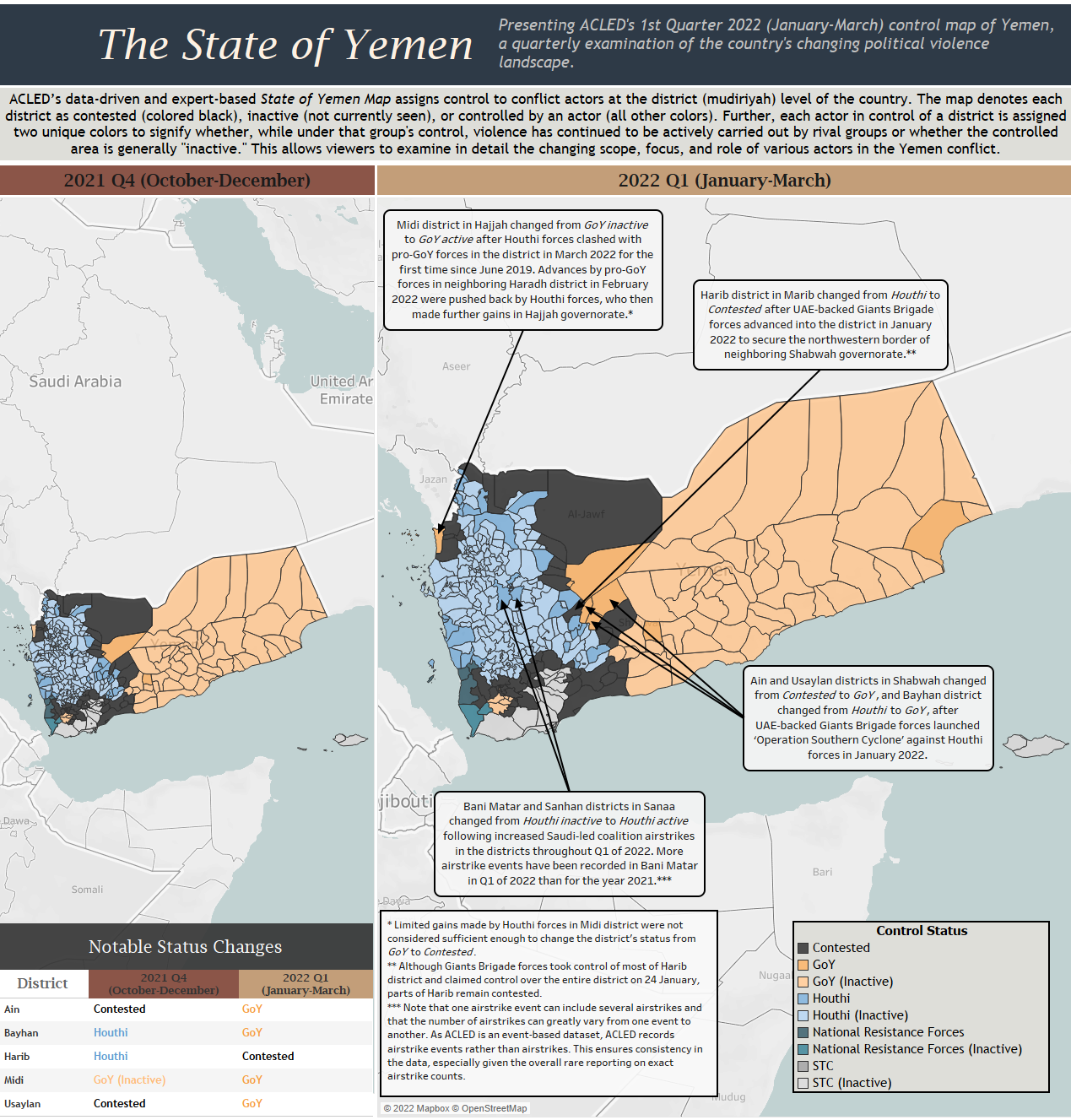
Major fronts reflected this fragmented geography. Hudaydah, the Red Sea port west of Sana’a, became the target of a UAE-backed offensive in June 2018; the December Stockholm Agreement established a governorate-wide ceasefire without settling national control. East of Sana’a, the renewed Houthi offensive toward Marib in February 2021 threatened a government stronghold and a major displacement destination. ACLED’s January–March 2022 control map recorded a predominantly Houthi-held northwest, but separate government, Southern Transitional Council, and National Resistance areas elsewhere. It classified Harib district in Marib as contested following a UAE-backed Giants Brigades advance, illustrating why control of a governorate cannot be inferred from possession of its capital. These dated territorial assessments describe military authority, not diplomatic recognition: Houthi control of Sana’a did not make its administration Yemen’s internationally recognized government. (yemen.un.org)
Leadership, organization, and territorial government
Abdul-Malik al-Houthi’s authority stands above the movement’s formal governing institutions. He sets strategic direction without occupying the presidency of its Supreme Political Council or a cabinet position. The distinction separates leadership of the movement from administration of the territory it controls in Yemen. The United Nations Panel of Experts’ October 2025 organizational chart placed him above the military command as commander-in-chief; it identified Abdullah Yahya al-Hakim as head of military intelligence and reconnaissance and Yahya Saree as military spokesperson. Political representation and negotiation constitute another branch of responsibility: Mohammed Abdulsalam has served as the movement’s spokesperson and chief negotiator, meeting the United Nations envoy and officials in Oman. These public responsibilities do not establish that officeholders possess equal influence over internal decisions. (acaps.org)
The constitutional declaration issued on 6 February 2015 attempted to convert military control into an institutional framework. It declared parliament dissolved and provided for a 551-member Transitional National Council, a five-member Presidential Council elected by that body, and a transitional government. The Revolutionary Committee was assigned responsibility for organizing the transition; Mohammed Ali al-Houthi headed the Supreme Revolutionary Committee. These provisions were announced arrangements, not evidence that all the proposed bodies subsequently functioned as specified. The declaration also retained the existing constitution and laws insofar as they did not contradict its provisions, rather than replacing the entire inherited legal system. (constitutionnet.org)
A different formal structure emerged from the alliance with former president Ali Abdullah Saleh’s General People’s Congress (GPC). Their agreement of 28 July 2016 provided for a ten-member Supreme Political Council, divided equally between the two sides and their allies. In November, the council announced a 42-person National Salvation Government headed by GPC politician Abdel-Aziz bin Habtour. These institutions combined Houthi authority with personnel and networks inherited from the former governing party; they did not receive international recognition as Yemen’s government. Mahdi al-Mashat subsequently became the public head of the council, a position documented in UN reporting for 2018 and again in 2025. (arabic.cnn.com)
Alongside ministries and local administrations, the movement developed a supervisory network whose authority depended on loyalty to its leadership rather than the ordinary civil-service hierarchy. A June 2020 ACAPS study described each governorate’s general supervisor, or mushrif, as the governor’s “shadow counterpart,” with subordinate district supervisors and specialized educational, social, and security supervisors. Its sample of 14 general supervisors serving in December 2019 included eight from Saada; governors, by contrast, had more geographically diverse origins. Supervisors could pressure formal officials to implement movement directives, while inherited employees continued administrative work. At neighbourhood level, the aqil—a local official maintaining residents’ records and distributing subsidized cooking gas—could remain a civil servant while operating under Houthi supervision. After December 2017, appointments of loyalists as ministers and governors increasingly merged the parallel and formal hierarchies. (acaps.org)
Relations with tribal leaders likewise combined cooperation with coercion rather than following a single model. Some tribal groups supported Houthi advances, while others resisted them; local rivalries, access to money and weapons, and attitudes toward the previous government shaped these choices. A 2022 Sana’a Center study documented the displacement of sheikhs’ authority by supervisors and pressure on tribal leaders to supply fighters under a “document of tribal honor” introduced in 2015. It also traced the changing position of Sheikh Yasser al-Awadi, a former Saleh–Houthi ally whose tribal mobilization in al-Bayda was defeated by Houthi forces in June 2020. Cooperation with a sheikh or retention of a GPC official therefore did not necessarily preserve that intermediary’s independent authority. (sanaacenter.org)
Revenue, economic administration, and civilian services
Houthi authorities finance their administration through taxation, customs duties, commercial revenues, and compulsory levies. The United Nations Panel of Experts’ 2025 report documented taxes on imports and sales, including fuel and cigarettes, alongside asset seizures, extortion, and smuggling. Telecommunications provide another revenue stream: Houthi-controlled companies collect payments for international calls and roaming, including usage by subscribers in government-controlled territory. The Panel also recorded fundraising text messages requesting 100-rial contributions for missile and drone forces. These domestically collected revenues are distinct from external financial assistance; neither commercial turnover nor the value of seized assets necessarily represents money available for public expenditure. The World Bank’s spring 2025 assessment noted that official public-finance data for Houthi-controlled areas were unavailable. (sanaacenter.org)
Economic administration operates within a divided national monetary system. Following the relocation of the recognized government’s central bank headquarters to Aden in 2016, rival authorities continued operating in Sana’a. On 18 December 2019, the Sana’a authorities tightened their prohibition on banknotes issued by the Aden central bank after 2016; strict enforcement followed in January 2020. Older notes consequently circulated in Houthi-controlled areas while newer notes circulated elsewhere, producing different exchange rates for the nominally same currency. Transfers between the two zones incurred substantial conversion charges: the World Bank reported that some Sana’a commercial banks charged up to 17 percent for cash transfers from government-controlled areas by late January 2020. By 2025, cash shortages and withdrawal restrictions continued to constrain household purchases and business transactions in Houthi-controlled territory. (thedocs.worldbank.org)
Public-sector salaries became a central dispute over the allocation of national revenues. Interrupted payments weakened both household incomes and the staffing of civilian institutions. A UN-mediated arrangement introduced in November 2019 directed taxes and customs from fuel imports through Hudaydah into a special central-bank account intended to contribute to civil-service salaries. In 2020, UN envoy Martin Griffiths reported that the arrangement had been suspended following a unilateral withdrawal of accumulated funds by Ansar Allah. Separately, the World Bank reported in spring 2025 that Houthi authorities had introduced a draft mechanism for exceptional salary payments involving graduated reductions and resources from bodies including the Teachers’ Fund. Revenue collection therefore did not translate automatically into regular payment of the inherited civil-service payroll. (worldbank.org)
Hudaydah and the other Red Sea ports connect revenue collection with access to food and fuel. Restrictions arose from different actors and mechanisms. The recognized government’s clearance requirements and coalition controls limited maritime access, while Houthi authorities imposed additional customs charges on fuel transported overland from government-controlled ports, increasing distribution costs. The April 2022 truce substantially expanded direct fuel deliveries: UN envoy Hans Grundberg reported that 26 ships carrying 720,270 metric tons entered Hudaydah between 2 April and 21 July, compared with fewer than 470,000 tons during all of 2021. These imports supported transport, electricity generation, water pumping, and hospitals, as well as providing taxable commerce. (press.un.org)
Civilian services continued through existing institutions but depended partly on external financing rather than regular domestic salary payments. A 2021 World Bank education project document described UNICEF-administered monthly incentives equivalent to US$50 for unpaid teachers and school staff in 11 governorates under the de facto authorities. Such incentives helped sustain education without restoring normal salaries. The same assessment identified teacher absence, inadequate learning materials, and unusable school buildings as obstacles to attendance and teaching. (unicef.org)
The health system similarly depended on supplies and operational support from international agencies. WHO reported supplying approximately 610,000 litres of generator fuel to 59 facilities across northern Yemen during 2025, maintaining operating theatres, laboratories, and critical medical equipment amid electricity shortages. Such assistance supplemented services in Houthi-controlled territory rather than constituting unrestricted financial support to the movement. Nationwide deterioration also reflected prolonged conflict, damaged infrastructure, shortages of personnel and medicines, institutional fragmentation, and declining financing; national health-facility statistics cannot be treated as measurements of Houthi-administered services alone. (emro.who.int)
Armed forces, weapons, and external support
The Houthis’ military expansion combined insurgent recruitment with the acquisition of Yemen’s state arsenals and the incorporation of experienced military personnel. Their advance into Sana’a in September 2014 was supported by army units loyal to former president Ali Abdullah Saleh; the subsequent alliance brought movement fighters and regular military formations into an increasingly integrated, though internally divided, fighting force. By December 2017, the Houthis had acquired sufficient military predominance to defeat Saleh’s loyalists when their alliance collapsed. These overlapping origins complicate estimates of personnel strength and organization. The United Nations Panel of Experts’ October 2024 report cited estimates of 30,000 fighters in 2015, 220,000 in 2022, and 350,000 in 2024, but explicitly stated that it could not independently verify the number of newly recruited fighters. These figures therefore should not be treated as an audited count of deployable troops. (chathamhouse.org)
Houthi capabilities extend beyond ground combat to long-range strikes, air defence, and maritime warfare. The UN panel recorded the display in September 2023 of ballistic missiles, cruise missiles, surface-to-air missiles, reconnaissance and one-way attack drones, fast attack craft, uncrewed surface vessels, and land and sea mines. A parade demonstrates possession or presentation of particular systems, rather than their numbers, readiness, or effectiveness. Technical research has identified several distinct sources within this arsenal: inherited Soviet-designed equipment, Iranian-derived missile families, and locally assembled systems. For example, the Mouhit anti-ship ballistic missile appears to be an adaptation of the older S-75 surface-to-air missile, incorporating Iranian guidance technology. This illustrates how captured stockpiles and external technical assistance can contribute to the same weapon. (digitallibrary.un.org)
Evidence for assistance from Iran includes examinations of intercepted components as well as comparisons with recovered weapons. In July 2024, the United States Defense Intelligence Agency reported that missile components seized on January 11 and 28 shared near-identical features with Iranian systems. Its findings covered ballistic, anti-ship cruise, and surface-to-air missile components, alongside anti-tank missiles and drones. Separately, the UN panel’s 2025 report documented concealed drones, complete drone kits, control equipment, and navigation modules in containers originating from China aboard a Hudaydah-bound vessel inspected in Djibouti in May 2025. The varied contents of these seizures distinguish supplies of complete weapons from shipments supporting assembly, maintenance, and production. (dia.mil)
External assistance also involves personnel and expertise. The UN panel’s 2024 report described information indicating technical assistance, training, weapons, and financial support from Iran, Iraqi armed groups, and Hezbollah. In its 2025 report, the panel attributed to confidential sources the continued presence of Hezbollah missile and drone specialists advising Houthi operations. Such findings document assistance and coordination; they do not by themselves establish comprehensive foreign control over Houthi military decisions. In an April 2025 assessment, missile specialist Fabian Hinz emphasized that the movement’s opaque command and decision-making structures made the extent of Iranian political and operational influence difficult to determine. (digitallibrary.un.org)
Local manufacture likewise varies substantially by weapon class. Hinz assessed that simpler drones, particularly the Sammad 3, were probably manufactured in Yemen, while still depending on imported propulsion, control, and guidance components. Some shorter-range ballistic missiles could also be produced locally, whereas medium-range missiles and sophisticated cruise-missile technologies remained much more dependent on Iran. His assessment distinguished manufacturing airframes or simpler parts from producing specialized engines, seekers, and complete advanced systems. Consequently, a Houthi designation or an assertion of domestic production does not establish an entirely Yemeni supply chain: individual weapons may combine local fabrication, imported commercial components, Iranian technology, and final assembly inside Yemen. (iiss.org)
Red Sea shipping attacks and confrontation with Israel
The Houthis began launching missiles and drones toward Israel in October 2023, presenting their campaign as support for Palestinians during the Gaza war. Maritime attacks followed in November. On 19 November, Houthi forces seized the Bahamas-flagged, Japanese-chartered vehicle carrier Galaxy Leader by helicopter boarding; its 25 crew members remained captive until 22 January 2025. The movement initially announced that it would target Israeli-linked shipping, subsequently extending its declared criteria to vessels bound for Israeli ports and ships associated with the United States and United Kingdom. These announcements did not reliably describe the vessels actually attacked: independently documented incidents included ships with little or no connection to Israel or the other stated targets. (congress.gov)
The campaign affected the southern Red Sea, the Bab el-Mandeb strait connecting it to the Gulf of Aden, and waters farther east. This corridor provides access to the Suez Canal on routes between Asia and Europe. Shipowners faced a choice between exposure to attacks and longer voyages around Africa’s Cape of Good Hope. In February 2024, UN Trade and Development reported that Suez transits had fallen 42 percent from their peak and weekly container-ship transits by 67 percent. Its April assessment estimated that diversion around Africa added approximately 12 days to an Asia–Europe journey. Longer voyages increased fuel consumption and tied up vessels and containers, while heightened risk raised insurance premiums and freight costs. The consequences for crews included death, injury, abandonment of damaged vessels, and captivity—not merely disrupted delivery schedules. (unctad.org)
International responses combined maritime protection with attacks on Houthi positions ashore. The US-led Operation Prosperity Guardian organized multinational maritime security operations, while the European Union launched its separate, defensive Operation Aspides on 19 February 2024 to accompany and protect merchant vessels. American and British forces began coordinated strikes against Houthi military facilities on 12 January 2024. The British government cited attacks on shipping and the 9 January assault involving British and American warships; naval forces reported intercepting the incoming weapons. Houthi attacks on US naval vessels nevertheless continued, and American airstrikes intensified from 15 March 2025. Confirmed launches and interceptions should be distinguished from Houthi announcements claiming successful hits on warships. (defense.gov)
Direct exchanges with Israel also escalated. On 19 July 2024, a Houthi-claimed drone attack struck a residential building in Tel Aviv, killing one person. Israel responded on 20 July with airstrikes in and around Hudaydah port. A further escalation followed the Houthi missile strike at Ben Gurion Airport on 4 May 2025, which injured civilians and disrupted air travel. Israeli retaliatory strikes hit Yemeni ports and, on 6 May, Sana’a airport; the UN Panel of Experts subsequently documented damage to airport infrastructure and the destruction of three civilian aircraft. These incidents established physical outcomes beyond the parties’ broader claims about targeting and military effectiveness. (dppa.un.org)
On 6 May 2025, Oman announced a US–Houthi ceasefire under which neither side would target the other, including American vessels in the Red Sea and Bab el-Mandeb. It was not an agreement ending the confrontation with Israel: Houthi spokesperson Mohammed Abdulsalam explicitly said Israel was excluded. Nor did it terminate attacks on other merchant shipping. Renewed assaults on Magic Seas and Eternity C on 6–7 July led to both vessels’ sinking; the International Maritime Organization reported at least three fatalities aboard Eternity C. (fm.gov.om)
The suspension of attacks on Israel after the Gaza ceasefire took effect on 10 October 2025 was a separate development. In November, the Houthis signaled that attacks on Israel and Red Sea shipping had stopped, while linking possible resumption to renewed fighting in Gaza. A Congressional Research Service assessment dated 20 February 2026 reported that the May 2025 US–Houthi truce had held and that attacks on Israel had been suspended since October. Those dated observations describe distinct pauses, rather than a comprehensive settlement covering every potential target or guaranteeing their permanence. (acleddata.com)
Human rights, civilian protection, and humanitarian access
The United Nations Group of Eminent Experts reported in 2020 that it had reasonable grounds to believe Houthi authorities were responsible for arbitrary detention, enforced disappearance, torture, and denial of fair-trial rights. It investigated 21 disappearance cases attributed to Houthi forces in Sana’a and verified torture of 14 men and one boy at Houthi-operated Al-Saleh Prison in Ta’izz, including coercion to obtain confessions. These were investigative findings, not criminal convictions of alleged perpetrators. Restrictions on freedom of expression included the prosecution of ten journalists for their broadcasts and writing; four received death sentences on 11 April 2020. The experts also documented arbitrary detention, torture, and procedural violations against members of the Bahá’í Faith. Hamed bin Haydara’s death sentence was upheld in March 2020, followed by a pardon; Bahá’í detainees were released and expelled from Yemen on 30 July. (documents.un.org)
Recruitment and use of children continued after formal protection commitments. On 18 April 2022, the Houthis signed a UN action plan covering recruitment, including support roles, killing and maiming, attacks on schools and hospitals, and other grave violations. It required identification and release of children from their ranks within six months and support for reintegration; Virginia Gamba, the Secretary-General’s special representative for children and armed conflict, signed as a witness. Nevertheless, the Secretary-General’s report covering 2024 attributed the recruitment and use of 85 boys to the Houthis. The UN’s account of 2025 continued to express concern about recruitment, reported summer camps, and Houthi military use of schools and hospitals—conduct distinct from attacks against those facilities, but also disruptive to civilian education and healthcare. (childrenandarmedconflict.un.org)
Restrictions affecting women and girls were enforced through identifiable administrative bodies. In a communication dated 2 December 2022, UN independent experts described reports that the Houthi Land Transport Regulatory Authority had issued an August verbal directive prohibiting women from travelling without a mahram, or male relative, within Houthi-controlled territory, into government-controlled areas, or abroad. The experts also reported that the Supreme Council for the Management and Coordination of Humanitarian Affairs and International Cooperation required a mahram’s name in female Yemeni aid workers’ travel-permit applications. Enforcement reportedly expanded from December 2020 onward, obstructing field assessments and assistance to women. The same communication described a January 2021 decision by Houthi-controlled health authorities in Hajjah requiring a prescription, marriage certificate, and the husband’s presence and consent before women could obtain family-planning methods. These measures were reported policies and practices, rather than explanations based on generalized religious or cultural characteristics. (spcommreports.ohchr.org)
Detention of humanitarian personnel directly affected access. In their joint statement of 3 June 2025, UN agency and international NGO heads reported that 23 UN personnel and five international NGO personnel remained arbitrarily detained by Houthi authorities. The statement marked one year since the June 2024 arrests, while noting that some personnel had been held since 2021. It also recorded the deaths in detention of one UN employee and one Save the Children employee. In February 2025, further detentions and inadequate security guarantees had prompted the UN to pause all operations and programmes in Saada governorate, pending arrangements for staff release and safe delivery of assistance. (yemen.un.org)
Civilian harm occurred within a multi-party conflict: UN investigators also attributed violations to Yemeni government forces, the Southern Transitional Council, and Saudi-led coalition members, and identified coalition import restrictions as contributing to shortages and inflation. These broader economic effects were distinct from direct violence and interference with relief delivery. In Houthi-controlled areas, the UN’s account of 2025 described additional aid-worker detentions and seizures of UN facilities following an August Israeli airstrike that killed senior Houthi officials; several humanitarian agencies consequently paused critical operations. (documents.un.org)
Peace negotiations, sanctions, and international status
The Houthis’ administration of territory is distinct from diplomatic recognition as the government of Yemen. Their control of Sana’a and inherited state institutions constitutes de facto authority; it does not replace the status of Yemen’s internationally recognized government. The United Nations has negotiated with Houthi representatives as a party to the conflict, not as the internationally recognized government. This distinction also appears in Security Council Resolution 2216, adopted on 14 April 2015, which demanded Houthi withdrawal from areas seized during the conflict, relinquishment of weapons taken from military and security institutions, and an end to actions reserved to the legitimate government. (chathamhouse.org)
The Stockholm Agreement, concluded on 13 December 2018 through UN-mediated consultations, comprised three arrangements: an agreement concerning Hudaydah city and the ports of Hudaydah, Salif and Ras Issa; an implementation mechanism for prisoner exchanges; and a statement of understanding on Taiz. Its Hudaydah provisions combined a ceasefire with mutual force redeployment. Resolution 2451 endorsed the arrangements, while the United Nations Mission to support the Hudaydah Agreement, established in January 2019, supported implementation. A joint Redeployment Coordination Committee brought government and Houthi representatives together under UN chairmanship to oversee the ceasefire and redeployment process. The detainee track operated separately through a supervisory committee co-chaired by the UN envoy’s office and the International Committee of the Red Cross; in March 2023, negotiations under this mechanism produced an implementation plan to release 887 conflict-related detainees. These were limited agreements rather than a national political settlement. (osesgy.unmissions.org)
A UN-brokered nationwide truce began on 2 April 2022, initially for two months, covering operations inside Yemen and cross-border attacks. Its provisions included fuel-ship access to Hudaydah, specified commercial flights from Sana’a, and discussions on opening roads in Taiz and other governorates. Renewed twice, it expired on 2 October 2022 without a further agreement, although reduced military activity continued afterward. Subsequent mediation involved UN envoy Hans Grundberg, Saudi Arabia and Oman. In December 2023, the parties committed to measures including a nationwide ceasefire, public-sector salary payments, resumed oil exports, road openings and further easing of airport and port restrictions. Grundberg’s March 2024 briefing described negotiations to translate those commitments into a UN roadmap: commitments to negotiate implementation were not an implemented comprehensive peace agreement. (osesgy.unmissions.org)
The Security Council sanctions framework distinguishes individual financial and travel restrictions from restrictions on arms supplies. Resolution 2140 of 26 February 2014 established targeted asset freezes, travel bans, a sanctions committee and a Panel of Experts. Resolution 2216 added a targeted arms embargo in 2015; Resolution 2624 of 28 February 2022 expressly subjected the Houthi movement as an entity to that embargo. The movement’s arms-embargo listing is therefore distinct from the asset freezes and travel bans attached to individual listings. Resolution 2722, adopted on 10 January 2024, demanded an immediate end to Houthi attacks on merchant and commercial vessels and release of the Galaxy Leader and its crew; it did not establish a new comprehensive economic embargo on Yemen. Resolution 2664 of December 2022 separately provided a humanitarian exemption to UN asset-freeze measures for specified humanitarian activities and providers. (main.un.org)
United States designations follow a separate domestic legal framework. Ansarallah’s Foreign Terrorist Organization (FTO) and Specially Designated Global Terrorist (SDGT) designations took effect on 19 January 2021; Secretary of State Antony Blinken revoked both effective 16 February 2021, citing humanitarian consequences. An SDGT designation took effect again on 16 February 2024. The renewed FTO designation was announced on 4 March 2025 and became legally effective upon Federal Register publication on 5 March. FTO designation criminalizes knowing provision of material support within the scope of US jurisdiction, while sanctions regulations restrict transactions involving blocked property. On 5 March 2025, Treasury updated general licenses covering specified agricultural commodities, medicines, medical devices and personal remittances, alongside existing authorizations for international organizations and nongovernmental humanitarian activities; these were defined authorizations, not a blanket exemption for every transaction described as humanitarian. (2021-2025.state.gov)
References
- How Iran’s Islamic Revolution Does, and Does Not, Influence Houthi Rule in Northern Yemensanaacenter.org
- Yemen: Stemming the Rise of a Chaos Statechathamhouse.org
- Yemen: Fear of Failurechathamhouse.org
- Regime and Periphery in Northern Yemen: The Huthi Phenomenonrand.org
- The politics driving Yemen’s rising sectarianismsanaacenter.org
- Domestic Diversionary War and Conflict Endurance in Weak States: The Houthi Conflict in Yemen (2004–2010)publikationen.uni-tuebingen.de
- Beyond the Business as Usual Approach: Combating Corruption in Yemensanaacenter.org
- The Yemen Review Quarterly: January–March 2024sanaacenter.org
- Disappearances and Arbitrary Arrests in the Armed Conflict with Huthi Rebels in Yemenhrw.org
- All Quiet on the Northern Front?: Uninvestigated Laws of War Violations in Yemen’s War with Huthi Rebelshrw.org
- The Huthis: From Saada to Sanaacrisisgroup-staging.sbx.so
- National Dialogueosesgy.unmissions.org
- Yemen Conflict Alertcrisisgroup-staging.sbx.so
- Situation of human rights in Yemen, including violations and abuses since September 2014 — A/HRC/42/CRP.1yemen.un.org
- The Peace and National Partnership Agreementpeacemaker.un.org
- Secretary-General Welcomes Signing of Peace, National Partnership Agreement in Yemen, Expects its Implementation without Delaypress.un.org
- Special Envoy Yemendppa.un.org
- Political Will, Inclusive Dialogue Key to Ending Conflict in Yemen, Special Envoy Tells Security Councilpress.un.org
- The State of Yemen: Q4 2021–Q1 2022 — control mapacleddata.com
- ACAPS Thematic Report: The Houthi Supervisory Systemacaps.org
- Letter dated 15 October 2025 from the Panel of Experts on Yemen addressed to the President of the Security Councilun.org
- Grundberg to Asharq Al-Awsat: Commitments Key to Yemen Peace Roadmaposesgy.unmissions.org
- Office of the Special Envoy for Yemen — Official Telegram updatest.me
- The Revolutionary Committee issues a Constitutional Declaration to organize the foundations of governance during the transitional period in Yemenconstitutionnet.org
- Mohammed al-Houthien.wikipedia.org
- الحوثيون وصالح يؤسسون مجلسا لحكم اليمن ومواجهة السعودية.. والمخلافي: أضاعوا فرصة السلامarabic.cnn.com
- Final report of the Panel of Experts on Yemen, S/2017/81securitycouncilreport.org
- Final report of the Panel of Experts on Yemen, S/2019/83documents.un.org
- Tribes and the State in Yemensanaacenter.org
- The Economy — The Yemen Review Quarterly: October-December 2025sanaacenter.org
- Yemen Economic Monitor: Persistent Fragility Amid Rising Risksdocuments1.worldbank.org
- Yemen Monthly Economic Update, January 2020thedocs.worldbank.org
- Macro Poverty Outlook, April 2025thedocs.worldbank.org
- Concerns and hopes of Yemenis at heart of UN plans for better futureosesgy.unmissions.org
- Amid Violence, Decreased Humanitarian Aid, World Must Not Leave Yemen Behind, Emergency Relief Coordinator Tells Security Councilpress.un.org
- Yemen: Fuel Supply Dynamicsacaps.org
- Press release on the implementation of the truce and prospects of its renewalosesgy.unmissions.org
- World Bank education project documentunicef.org
- Saving lives on the frontline: how the Contingency Fund for Emergencies sustained Yemen’s health response in 2025emro.who.int
- Final report of the Panel of Experts on Yemen, S/2024/731documents.un.org
- Final report of the Panel of Experts on Yemen, S/2024/731digitallibrary.un.org
- DIA Report Showcases Iranian Origin of Houthi Weapons Interdicted at Seadia.mil
- Made in Yemen? Assessing the Houthis’ arms-production capacityiiss.org
- Yemen: Conflict, Red Sea Security, and U.S. Policycongress.gov
- Applying the Law of the Sea to Protect International Shippingun.org
- Statement on the release of the Galaxy Leader crewimo.org
- Report on Houthi attacks on merchant and commercial vessels in the Red Sea, 8 June–9 July 2025wwwcdn.imo.org
- U.S., Partners’ Forces Strike Houthi Military Targets in Yemendefense.gov
- PM statement on defending the UK and its allies: 15 January 2024gov.uk
- Noon briefing of 14 May 2025un.org
- USG DiCarlo briefs Security Council on situation in Hudaydahdppa.un.org
- Situation of human rights in Yemen, including violations and abuses since September 2014: A/HRC/45/6documents.un.org
- New Action Plan to Strengthen the Protection of Children Affected by Armed Conflict in Yemen Signed with the Houthischildrenandarmedconflict.un.org
- Yemenchildrenandarmedconflict.un.org
- Communication AL OTH 124/2022spcommreports.ohchr.org
- One Year in Detention: Heads of United Nations Agencies and INGOs renew demand for release of staff detained in northern Yemenyemen.un.org
- Note to Correspondents: on the pause of UN operations in Sa’ada governorate of Yemenunmha.unmissions.org
- Security Council Demands End to Yemen Violence, Adopting Resolution 2216 (2015), with Russian Federation Abstainingpress.un.org
- Stockholm Agreementosesgy.unmissions.org
- Security Council Authorizes Immediate Deployment of Advance Team to Monitor Force Withdrawals, Ceasefire in Yemen, Adopting Resolution 2451 (2018)press.un.org
- Report on implementation of resolution 2451 (2018), S/2019/11digitallibrary.un.org
- Yemen: The parties agree to release hundreds of conflict-related detaineesir.icrc.org
- United Nations Initiative for a two-month Truceosesgy.unmissions.org
- Secretary-General's Statement on a Nationwide Truce in Yemenun.org
- Fresh Houthi Attacks Risk Renewing Conflict, Humanitarian Plight in Yemen, Special Envoy Tells Security Council, Urging Maximum Restraintpress.un.org
- Briefing by the UN Special Envoy for Yemen, Hans Grundberg, to the Security Councilyemen.un.org
- S/RES/2140 (2014)main.un.org